

AWS Direct Connect vs VPN: Hybrid Cloud Networking for DevOps
When to use Direct Connect vs Site-to-Site VPN for secure on-prem to AWS connectivity.

🎯 Target Audience: Beginner → Junior DevOps & Cloud Engineers
🧠 Key Concepts: Hybrid Cloud, VPC, VPN, Direct Connect, On-Prem Networking
⏱ Estimated Read Time: ~10 minutes
🌍 Real-World Focus: How organizations securely connect on-prem infrastructure to AWS
🌐 Why Hybrid Networking Matters
In real companies (not just tutorial labs), everything isn’t “fully in the cloud.” Most organizations already have existing data centers, internal applications, employee networks, or compliance requirements that can’t just be migrated overnight.
So instead of choosing Cloud or On-Prem, companies use both.
This is called Hybrid Cloud, and to make it work, we need a way to connect on-prem networks to AWS securely.
That’s where Site-to-Site VPN and AWS Direct Connect come in.
1️⃣ What Is AWS Site-to-Site VPN?
🧠 Explanation
AWS Site-to-Site VPN is a secure, encrypted connection between your on-prem network and AWS VPC over the public internet.
It uses IPSec tunnels to encrypt data while it travels across the Internet.
💡 Analogy
Think of VPN like using Google Maps to drive on public roads. You share the road with everyone, but your car is locked and your conversations are private.
It works well, but sometimes there’s traffic, latency, or roadblocks.
🌍 Real-World DevOps Use Case
A company needs quick and low-cost connectivity to AWS while migrating databases and applications gradually.
Easy to set up
Costs almost nothing
But performance varies based on internet quality
🔧 Example Setup Flow
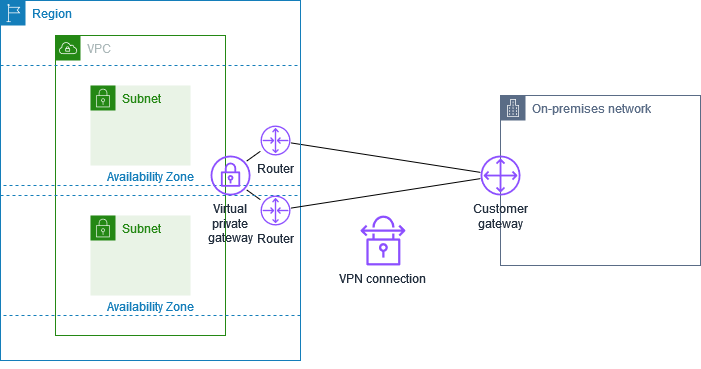
On-Prem Router → IPSec Tunnel → AWS Virtual Private Gateway → VPC
🎯 Interview Q&A
| Question | Best Answer |
| Does Site-to-Site VPN use the public internet? | Yes, but it encrypts all data using IPSec. |
| Is VPN good for production traffic? | It’s fine for small workloads, testing, or temporary hybrid setups — but not ideal for high throughput. |
| What happens if the internet is unstable? | The VPN connection may drop, or latency may increase. |
2️⃣ What Is AWS Direct Connect?
🧠 Explanation
Direct Connect (DX) is a dedicated physical network connection between your data center and AWS. It does not use the public internet; it’s private, stable, and faster.
💡 Analogy
If VPN is using public roads, Direct Connect is building your own private highway 🚊🚦. No traffic. No interruptions. No middlemen. Just consistent, high-performance connectivity.
🌍 Real-World DevOps Use Case
Banks, telecoms, SaaS platforms, and large enterprises often need:
Low latency
Guaranteed bandwidth
Compliance-controlled network paths
🔧 Example Setup Flow
On-Prem Datacenter → Direct Connect Router → AWS Direct Connect Gateway → VPC
🎯 Interview Q&A
| Question | Best Answer |
| Why use Direct Connect instead of VPN? | It provides higher performance, lower latency, and private connectivity, not dependent on public internet. |
| Is Direct Connect expensive? | Yes, it has setup + port + data transfer costs. |
| Do companies use both DX and VPN together? | Yes, VPN is often used as a failover backup to Direct Connect. |
3️⃣ Direct Connect vs VPN (Summary Table)
| Feature | VPN | Direct Connect |
| Connectivity | Over the internet | Private dedicated link |
| Latency | Variable | Low + stable |
| Throughput | Limited by internet bandwidth | Up to 100 Gbps |
| Cost | Cheap | Higher cost |
| Setup Time | Quick | Weeks to schedule + configure |
| Best For | Small to mid workloads, testing | Production workloads, compliance, steady data transfer |
4️⃣ Real DevOps Scenario (Common in Enterprise)
Your company has:
Internal database in on-prem datacenter
Microservices deployed in AWS VPC
Teams need apps to communicate securely and reliably
Recommended Architecture:
| Connection | Purpose |
| Direct Connect | Primary communication channel (stable + fast) |
| Site-to-Site VPN | Backup link if Direct Connect fails |
This ensures high availability and business continuity.
5️⃣ Architecture Diagram
Direct Connect

VPN Tunnel
6️⃣ Common Misconfigurations & Best Practices
| Mistake | Fix |
| Not enabling route propagation | Ensure routes propagate to the route tables |
| Using only VPN for production workloads | Use VPN only as a secondary/failover |
| Exposing DBs publicly | Keep DB subnets private always |
| Forgetting BGP routing for Direct Connect | Configure correct ASN + route advertisements |
⚡ Quick Recap
Hybrid Cloud = Cloud + On-Prem working together
VPN → Fast to set up, low cost, but internet-dependent
Direct Connect → Private, fast, reliable, but costs more
Best practice → Use DX + VPN failover for production networks
🧪 Mini Hands-On Lab (Optional Practice)
Goal: Create a test VPN connection between AWS and a local StrongSwan server.
Steps:
Create a VPC + Subnets in AWS
Create a Virtual Private Gateway
Run StrongSwan on a Linux VM (local or cloud)
Download the VPN configuration from AWS
Apply the config and establish the tunnel
Test connectivity with:
ping <Private EC2 IP>
🎉 Congrats: you just built a hybrid network simulation.
📚 References & Further Learning
AWS Official Docs:
AWS Site-to-Site VPN: https://docs.aws.amazon.com/vpn/latest/s2svpn
AWS Direct Connect: https://docs.aws.amazon.com/directconnect/latest/UserGuide
Virtual Private Cloud (VPC) Overview: https://docs.aws.amazon.com/vpc/latest/userguide
Architecture & Best Practices:
AWS Hybrid Networking Patterns: https://aws.amazon.com/architecture/hybrid
AWS Well-Architected Framework: https://aws.amazon.com/architecture/well-architected
Extra Learning Paths:
AWS Networking Learning Plan: https://explore.skillbuilder.aws/learn/lp/85
AWS Cloud Practitioner Essentials (Free): https://www.aws.training/Details/Curriculum?id=20685
👨💻 Written by: Abdulrahman A. Muhammad


